



When living off grid or preparing for emergencies, pain management becomes a serious concern. Headaches, muscle strain, joint inflammation, and fever do not stop simply because pharmacies close or hospitals become inaccessible. Early American pioneers understood this reality well. Doctors were rare, manufactured medicine was unavailable, and travel to towns could take weeks. Survival required dependable remedies that could be sourced locally and prepared with simple tools. Among the most trusted of these remedies was willow bark.

For generations, willow bark served as a primary pain reliever for frontier families. Long before aspirin existed, pioneers relied on this natural medicine to manage the aches and fevers that came with hard labor and harsh conditions. In a modern grid down scenario, the same knowledge can provide meaningful relief when commercial painkillers are gone. Learning how to identify, harvest, and prepare willow bark combines historical wisdom with practical survival medicine.
The medicinal use of willow bark extends back thousands of years. Ancient Greek physicians recommended it for pain and fever, and Indigenous peoples across North America used it extensively. When settlers moved west, they adopted this knowledge quickly. By the nineteenth century, willow bark had become a common component of frontier medicine for treating arthritis, back pain, headaches, and general soreness.
Willow trees belong to the genus Salix. Their bark contains salicin, a compound that the human body converts into salicylic acid after ingestion. Salicylic acid reduces inflammation, lowers fever, and eases pain. This same compound later became the basis for aspirin once chemists learned how to synthesize it in purified form. For pioneers, however, the tree itself functioned as the pharmacy.
Frontier families harvested bark primarily from young willow branches, where salicin concentration tends to be highest. Much of this knowledge came from Indigenous teaching combined with European folk medicine traditions. Once collected, the bark was dried and brewed into a bitter tea. Some individuals chewed fresh bark during long workdays to obtain mild relief. In both cases, effects typically appeared within half an hour as the body metabolized the salicin.
Salicin reduces pain and inflammation through well understood physiological mechanisms. Relief was most reliable for mild to moderate pain such as headaches, muscle soreness, and joint discomfort. Pioneers recognized that severe injuries required additional care, but willow bark remained a dependable first line remedy. Careful dosing mattered. Excessive intake could cause stomach upset or dizziness, which reinforced the importance of moderation. Even with these limitations, willow bark earned its place as a staple remedy due to its reliability and availability.
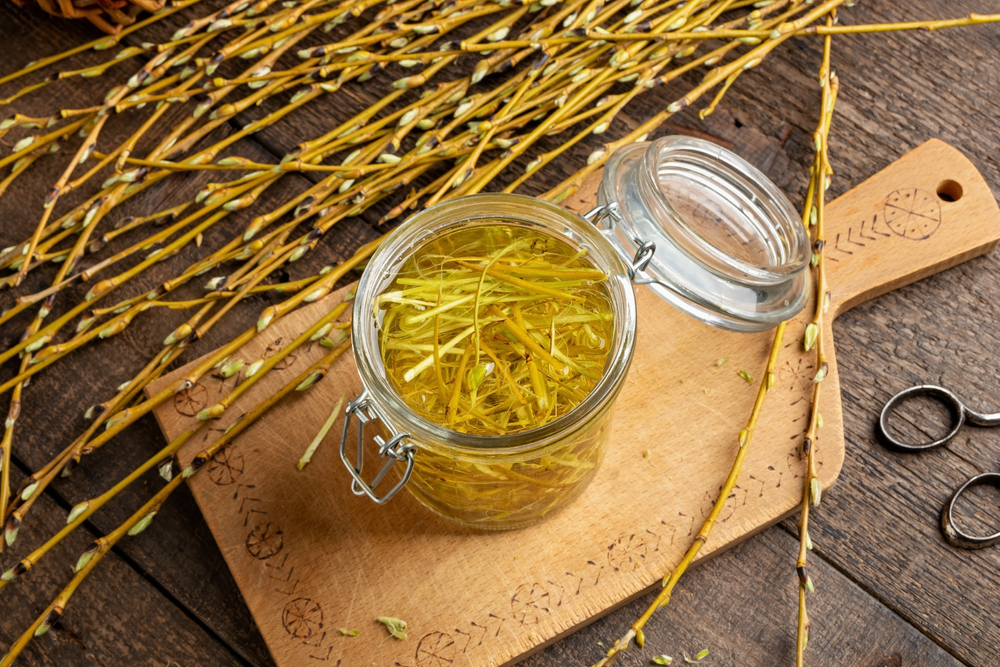
Correct identification and responsible harvesting are essential. Willows typically grow near water sources such as streams, ponds, and wetlands. They feature long, narrow leaves with fine serrated edges. Young bark appears smooth and yellowish or greenish, while older trunks develop rough gray bark.
Branches roughly the thickness of a thumb or smaller offer the best material. These younger shoots contain a thin outer bark and a pale inner bark rich in medicinal compounds. Spring remains the preferred harvest season because sap flow allows the bark to separate easily and salicin levels peak during this period.
Harvesting should be done carefully. Small sections should be taken from several branches rather than stripping a single limb completely. This approach protects the tree and ensures continued growth. After removal, the thin outer bark can be discarded if present. The flexible inner bark is retained for use.
For storage, inner bark can be cut into strips and air dried in a shaded, ventilated area until brittle. Properly dried bark stores well in jars or paper bags kept cool and dry. Many pioneers relied on stored bark throughout the year as part of their household medical supplies.
The most common preparation involved brewing a decoction. Bark requires simmering rather than simple steeping to extract its active compounds.
Dried bark is measured at approximately one to two teaspoons per cup of water. Fresh bark requires a slightly larger quantity due to moisture content. The bark is added to water and brought to a boil, then reduced to a low simmer. Simmering continues for ten to fifteen minutes, during which the liquid darkens.
After simmering, the pot is removed from heat and allowed to steep briefly. The liquid is then strained to remove bark fragments. The resulting tea has a bitter, woody taste that reflects its medicinal strength.
One cup is consumed at a time, followed by a waiting period to assess effect. Relief generally develops within thirty to sixty minutes. Up to two or three cups per day may be used for ongoing discomfort, with care taken to avoid stomach irritation. Fuel limitations may require shorter brewing times, though this reduces extraction efficiency.
Potency varies depending on species, season, and freshness. Adjustments should be made cautiously based on individual response.
For longer storage and more concentrated dosing, pioneers and later homesteaders prepared tinctures. A tincture extracts medicinal compounds using alcohol and preserves them for extended periods.
Dried bark is chopped and placed into a glass jar, filling it roughly halfway. High proof alcohol such as vodka, brandy, or grain alcohol is poured over the bark until fully submerged. The jar is sealed, labeled, and stored in a cool dark location.
The mixture steeps for four to six weeks, with gentle shaking every few days to encourage extraction. Over time, the liquid darkens as salicin dissolves into the alcohol. After steeping, the liquid is strained and transferred into a dark glass bottle for storage.
Tinctures are taken in small doses. One to two dropperfuls diluted in water may be used up to three times per day. Effects develop more gradually than with commercial painkillers but often last longer. Due to concentration, tinctures require careful dosing.
Willow bark deserves the same respect as manufactured pain relievers. Natural remedies vary in strength, and potency depends on preparation and source. Conservative dosing reduces the risk of side effects.
Individuals with aspirin or salicylate sensitivity should avoid willow bark. The compounds act similarly and may trigger allergic responses. Willow bark can irritate the stomach lining, especially when taken in excess or without food.
Salicin also affects blood clotting. Those with bleeding disorders or who take anticoagulant medications should avoid use. Willow bark should not be given to children or teenagers, particularly during viral illness. Pregnant and nursing women should also avoid it.
Medication interactions remain a concern in mixed treatment scenarios. When modern drugs are present, combining them with herbal remedies requires caution.
Willow bark rarely functioned alone. Pioneers layered treatments to improve outcomes. Herbal poultices were common. Crushed plants applied directly to sore joints or wounds helped reduce inflammation and discomfort. Mustard plasters warmed muscles and eased congestion. Plantain and jewelweed addressed skin irritation.
Salves and liniments provided topical relief. Herbs infused into fats or oils produced balms for muscles and joints. Alcohol or vinegar extracts served as rubs to stimulate circulation and ease stiffness.
Hot and cold compresses offered simple yet effective therapy. Warm applications relaxed muscles and encouraged blood flow. Cold water reduced swelling after injury. Alternating temperature supported healing with minimal equipment.

Pioneer medicine demonstrates how practical knowledge supports survival when modern systems fail. Willow bark stands as a proven example of nature providing effective pain relief through careful use and preparation. Learning to harvest and prepare this remedy builds medical independence and resilience.
Frontier families combined internal remedies with external care, rest, and observation. This layered approach remains relevant today. Preparing these skills before an emergency strengthens confidence and reduces reliance on fragile supply chains.
Willow bark represents more than pain relief. It reflects a mindset of preparedness rooted in observation, restraint, and respect for natural resources. With proper knowledge and care, it remains a valuable tool for anyone preparing to live without guaranteed access to modern medicine.






Read the full article here

