


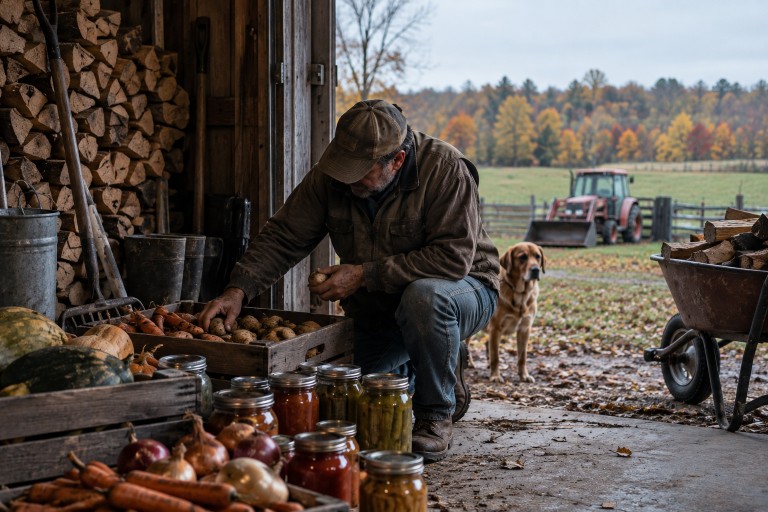

There used to be a date on the calendar when people knew the year could no longer be left half-finished.
By the end of that day, rents were due. Accounts were settled. Workers were hired. Harvest totals were known. And the household had to face one hard question.
Are we actually ready for winter?
That date was September 29.
For centuries in England, Michaelmas, the Feast of St. Michael, served as one of the old quarter days. It fell as the main harvest was ending and the colder months were closing in. Leases changed hands. Debts and rents came due. Workers might be hired for the season ahead. Families had a reason to look honestly at what the year had produced and what was still unfinished.
It is worth noticing that the day was a feast before it was a deadline. The ledger and the sanctuary sat on the same date. A household counted what it had, settled what it owed, and then gave thanks for the harvest it had been given. That ordering says something. Gratitude came after the honest accounting, not instead of it.
I find the whole idea more useful every year.

Modern life makes it remarkably easy to leave things hanging. Bills roll into another month. A broken gate stays broken until spring. The generator goes another season without maintenance. Borrowed tools sit in the garage. Pantry gaps get ignored because the grocery store is ten minutes away.
Then cold weather arrives, and every one of those small unfinished jobs starts demanding attention at once.
There is something here worth recovering. One day each year when the household stops postponing. One day to count what you have, settle what you owe, finish what matters, and walk into winter with fewer loose ends behind you.
Finish What You Owe
The settling of accounts is the part of Michaelmas that catches my attention first. Money owed had a date attached to it. I like that discipline.
Modern life lets us carry unfinished financial business indefinitely. A small credit-card balance stays another month. Somebody owes a relative money and nobody brings it up. A bill gets pushed forward. An unused subscription keeps charging quietly. An insurance policy has not been reviewed in years.
By late September, I want to know exactly where my household stands. What do we owe? What is coming due? What can be paid off, and what expense can be cut entirely? What large winter bills are waiting for us?
I may not clear every debt in one afternoon. But I can face the numbers and build a plan around them.
There is a real difference between owing money you are actively dealing with and owing money you have simply stopped thinking about.
Count The Harvest You Actually Have
Michaelmas came at the end of harvest for a reason. That was when people could finally see what a year of work had produced. A modern household should do the same thing.
September is when I take a serious look at the pantry, the freezer, the garden produce, the canned food, the fuel, the animal feed, and everything else we expect to carry into winter. I count what is really there.
A pantry can look full while holding ten jars of something nobody eats and very little of what the family actually uses. The freezer may be packed, but how many real meals are inside it? How much flour do we go through in a month? How long will the canned meat last? How much pet food is left, and how much of the shelf needs to be eaten soon?
I would rather find those gaps on a mild September afternoon than during a January storm.
Close The Jobs That Have Been Hanging Around
Every house carries unfinished work. A loose gutter. A gate that will not latch. A cracked window seal. A generator overdue for maintenance. Firewood still sitting in a pile where it was dumped. A vehicle that needs tires. A leaking faucet the whole family has learned to ignore.
Almost all of that is easier while the weather is pleasant. Cold makes every job harder. A twenty-minute repair in September becomes a miserable emergency in December.
So I give those jobs a deadline. By the end of the month, the important seasonal work should stop following me around the property.
There will always be another project. That does not mean every project deserves to stay unfinished.
Get Winter Supplies Into Position
Our ancestors understood that the productive part of the year was ending. Whatever the household needed through winter had to be in place before the ground froze. That logic still holds.
What I check
By the end of September I want eyes on the blankets, winter clothes, flashlights, batteries, heating equipment, fuel, medicines, vehicle supplies, and basic food storage. If we use a chimney, I want it inspected. I want the propane handled. I want the snow shovel somewhere I can actually find it in the dark.
What I test
Checking is not the same as testing. I want warm clothes tried on before the first freeze reveals that a child outgrew last year’s coat in July. I want the generator started before I am standing in freezing rain trying to remember why it would not run last winter.
Winter preparation gets more expensive and more stressful when everybody waits for the same cold forecast.
Settle Up With People Too
Accounts are not always financial.
Sometimes we owe somebody a phone call. A borrowed tool has been in the garage for six months. We promised to help a neighbor and never followed through. There is an apology that should have happened already. Somebody did real work for us that we never properly thanked them for.
An annual settling day should cover those obligations as well. Return what was borrowed. Keep the promise. Thank the person who helped you. Clear up the misunderstanding if it is within your power to clear.
Unfinished business between people takes up more room in the mind than we admit. Winter is a good season to enter with a clean conscience.
Decide What You Will Stop Carrying
Putting a household in order also means letting go of what no longer serves it.
I go through the equipment, clothing, food, paperwork, and supplies that piled up over the year. Some of it needs repairing. Some can be donated. Some food needs to be eaten soon. Some equipment needs replacing outright. And some of it has been sitting for five years because I told myself it might become useful one day.
Preparedness turns into clutter when nobody makes decisions. I want to know what I own, where it is, whether it works, and why I am keeping it.
A shed packed to the door is not automatically a prepared shed. Sometimes it is just a shed where nothing can be found.
Make Sure One Person Does Not Know Everything
The old Michaelmas hiring fairs were partly about arranging the labor a household would need for the year ahead. That makes me think about a different kind of inventory.
Who in your house knows how everything works?
Can another adult start the generator? Does everyone know where the main water shutoff is? Do the children know where the flashlights are kept? Who knows which medicines belong to whom, and how the backup heater runs? Where are the insurance papers?
Then the question underneath all of those. What happens if the one person who normally handles this is sick, traveling, or gone?
If every useful piece of knowledge in a household lives inside one head, the family has a weak point it cannot see. September is a good time to start handing that knowledge around.

Pick Your Own Michaelmas
You do not have to keep an old English feast day to use the idea behind it. I favor September 29 because generations before us already knew what that point in the year meant. The harvest is nearly in. The days are shortening. Winter is coming. Settle up.
Once a year, I want a single date when my household stops carrying avoidable unfinished business. Pay what can be paid. Count what has been stored. Finish the repairs that matter. Return what you borrowed. Test the winter equipment. Deal with the job you have been postponing since spring. Write down whatever still needs attention and put a real deadline beside it.
Then walk into the cold months knowing exactly where you stand.
Our ancestors had far fewer conveniences than we do. They also had a clearer relationship with the calendar. Certain work belonged to certain seasons, and eventually the season closed.
There came a point when preparation had to turn into readiness. Michaelmas marked that point.
Maybe September 29 still should. One honest count. One settled account. One household ready before the frost.






Read the full article here

